
Webinar recap | Real-Time Clinical Trials: Why the FDA's Vision Demands a New Data Foundation
The FDA will soon be ready to receive real-time trial data. Most sponsors can't produce it yet. Here's what a real-time data foundation requires, and why it matters now.
The following is a recap of our recent webinar with OmniScience CEO Angela Holmes and VP of Product Michael Bell.
Clinical trials remain the longest, costliest, and most document-heavy part of drug development, marked by an average 30-month gap between phases, roughly 400,000 pages of documentation per submission, and rising pressure on U.S. biotech's global competitiveness. The cost isn't just financial: it's medicines that could reach patients sooner but don't, and rare-disease programs where today's costs and timelines simply don't work.
That's the backdrop for one of the most consequential shifts in clinical development in years: the FDA's emerging vision for real-time clinical trials.
The Big Idea: Data That Speaks in Real Time
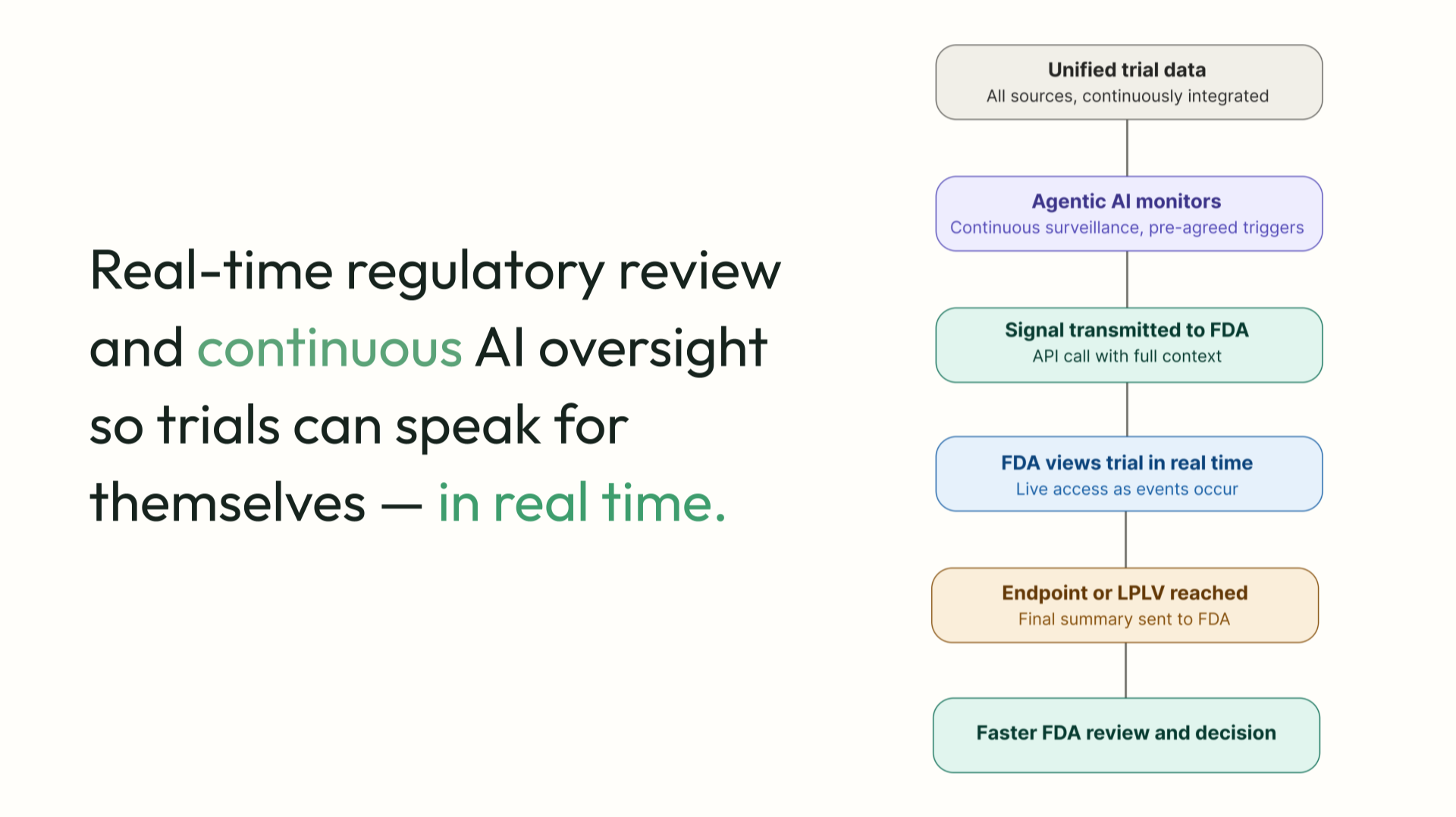
Late last year, the FDA approached OmniScience to explore what a real-time approach could look like in practice - using advanced computational models, real-time analysis, shared infrastructure, and automation to evaluate drugs and biologics faster, at lower cost, and with fewer participants. The vision, in short:
- Unified trial data, continuously, rather than assembled periodically for scheduled reviews
- AI-driven analysis at scale while the trial is running
- Insights shared with regulators in real time, not just at submission
- The long-term possibility of faster approvals based on live data rather than static, retrospective packages
- The ability to stop trials early for efficacy or futility, not just for safety as today's mechanisms allow
OmniScience validated this vision directly with sponsors. The response was consistent: pharma teams wanted the ability to act the moment a drug shows it's working. A pediatric oncology biotech modeled a scenario where earlier phase-transition decisions could bring a therapy to market two years sooner and save $25 million. Large pharma leaders also described board mandates to cut trial timelines by as much as 50% by 2030.
The numbers back up the urgency: analysts estimate 45% of the traditional submission process sits idle between phases, and closing that gap could unlock roughly $100 billion in value industry-wide, freeing capital to fund further innovation.
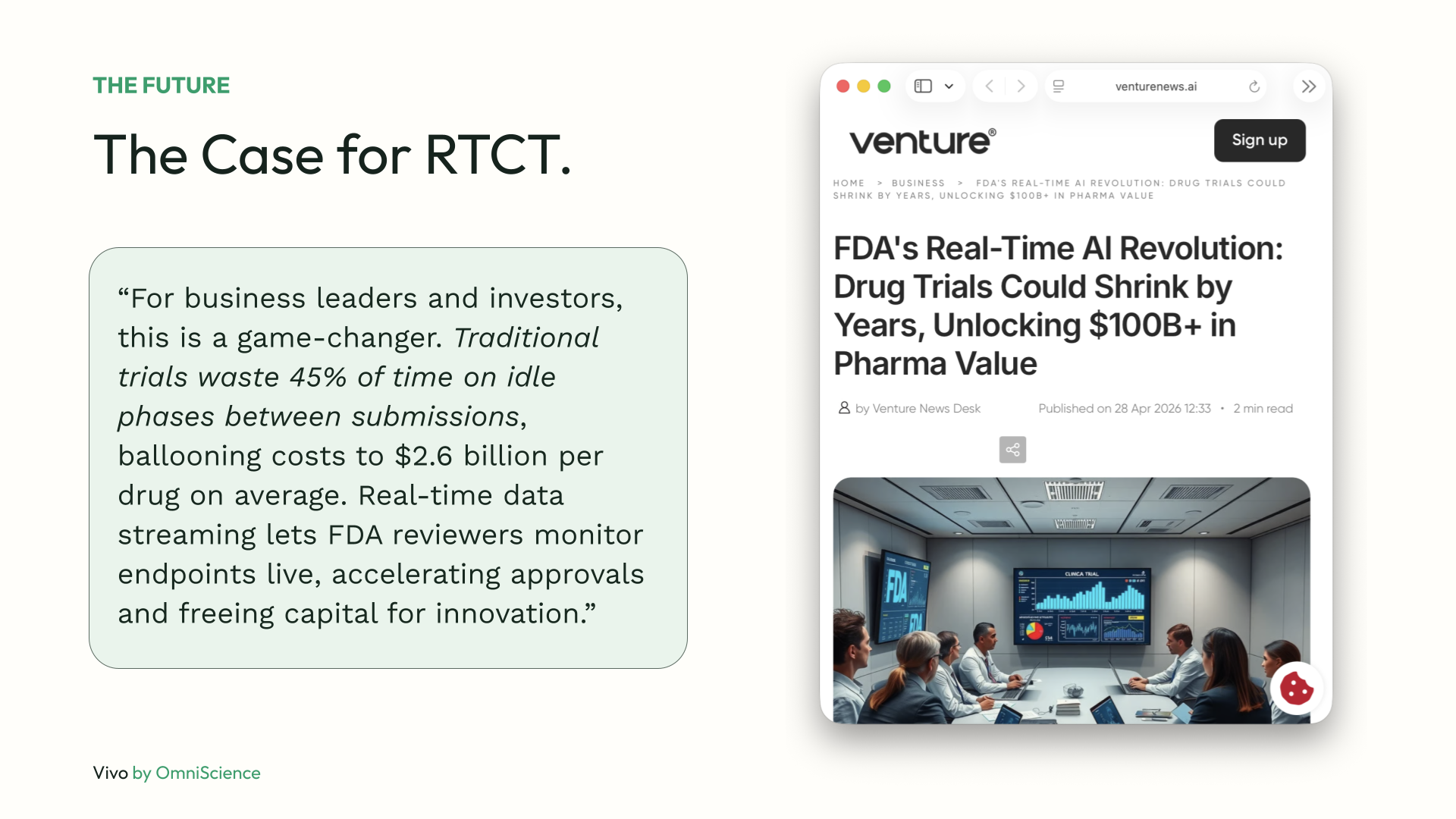
What Real-Time Oversight Actually Requires
The FDA's receiving infrastructure for real-time data largely already exists. What's missing is pharma's ability to generate a continuously integrated, compliant, real-time data foundation. That foundation needs to:
- Unify data across every source (EDC, labs, COAs, PROs, IRT, safety, CTMS, etc.) with full provenance and version control
- Stay contextualized against the protocol, including pre-agreed monitoring thresholds
- Account for data quality in-flight, before database lock, using a risk-based approach to what actually matters to primary endpoints, safety signals, and operational milestones
- Run modern statistical signal-detection, similar to established pharmacovigilance methods
- Remain fully auditable, transparent, and governed
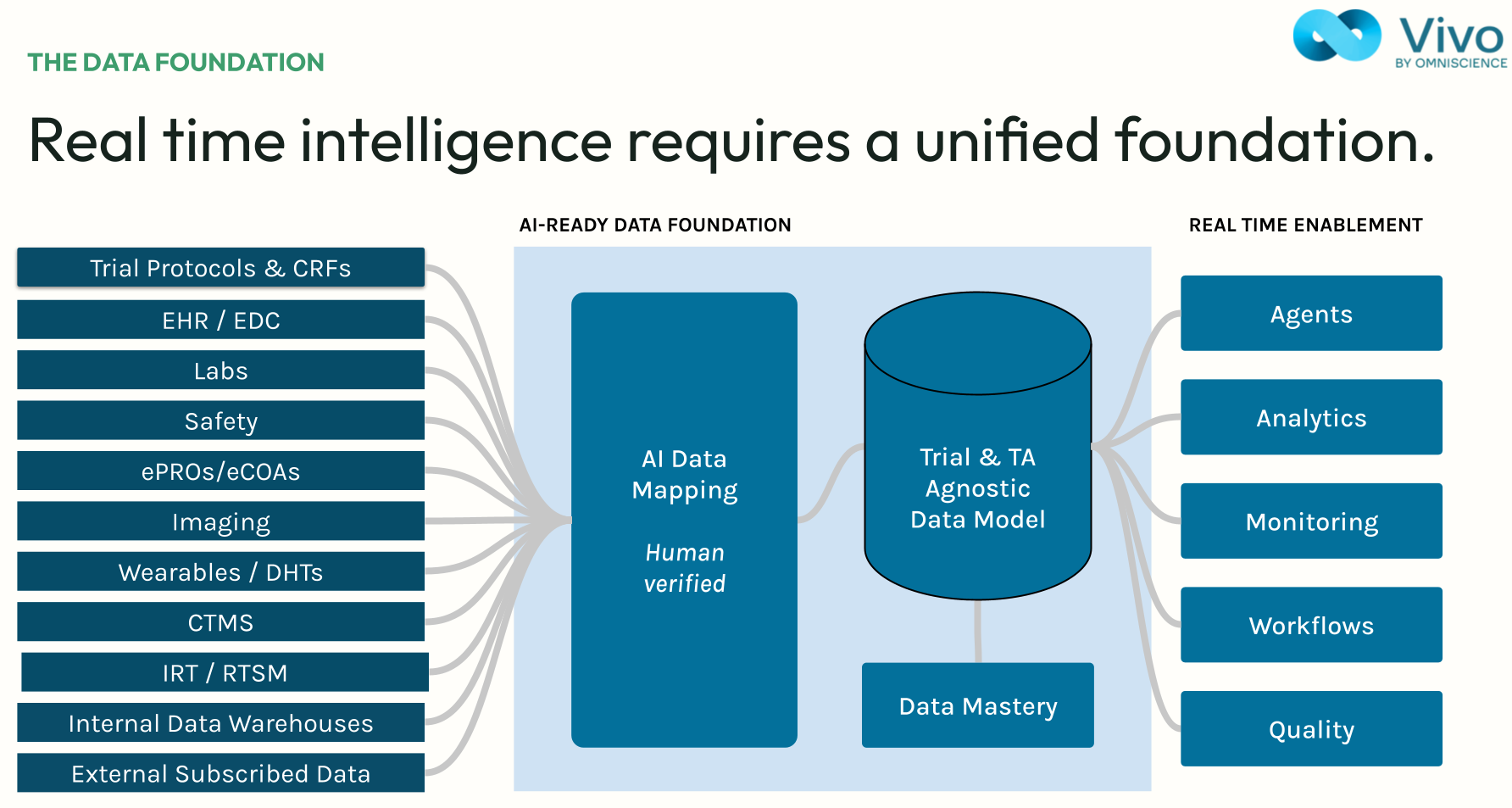
In effect, the industry needs to move from static, periodic dashboards to continuous, always-on monitoring to catch data quality issues, protocol deviations, and safety or efficacy signals while there's still time to act, rather than weeks or months after the fact.
Where the Industry Is Already Headed
This shift isn't only a regulatory conversation. Independent commentary from former FDA AI leadership has echoed the same theme: AI has transformed the back office and trial operations, but the middle of the trial, the in-flight data, remains underexploited, even though the technology to close that gap is mature enough today.
How OmniScience's Vivo Fits In
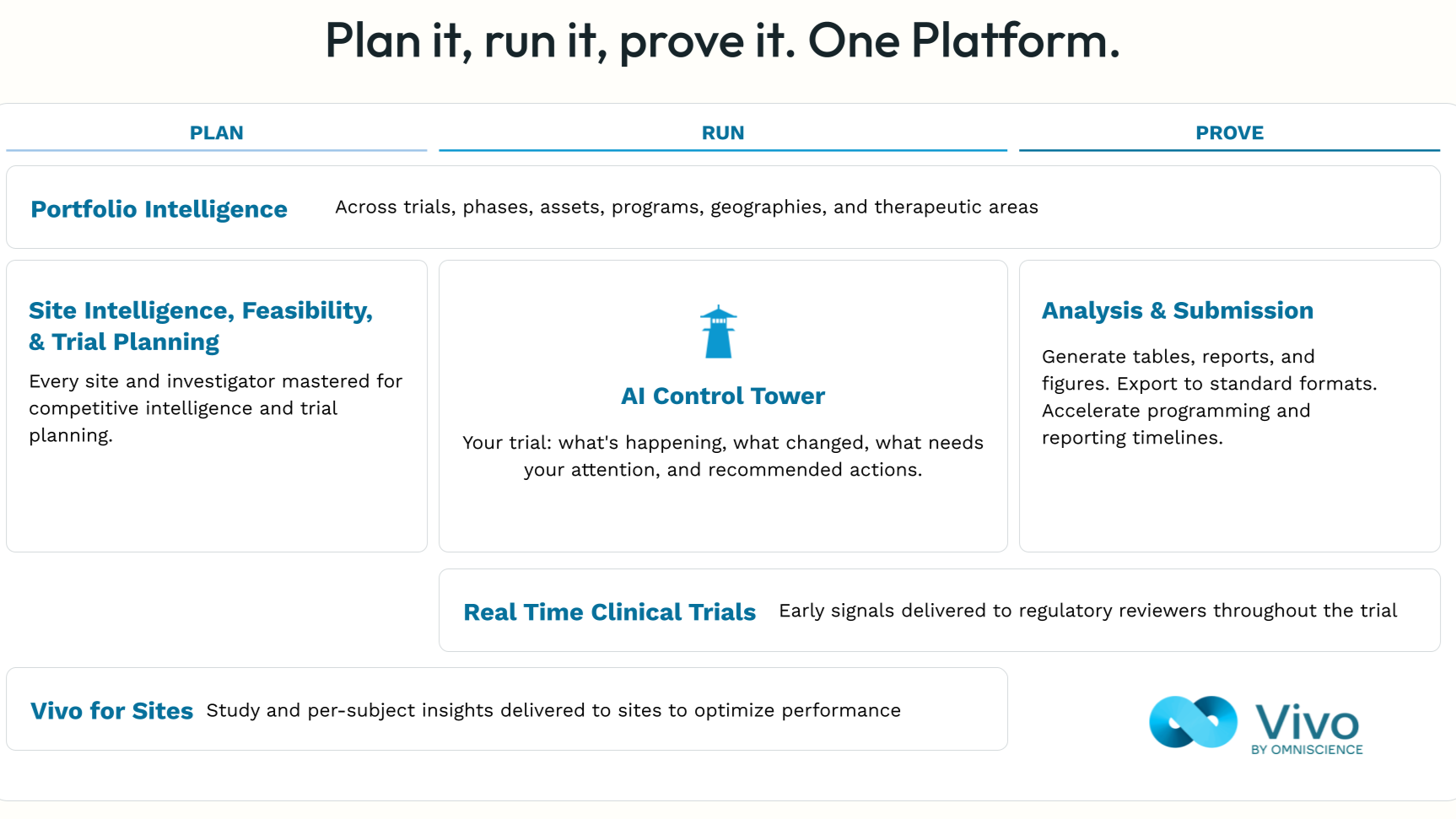
Since putting Vivo into production OmniScience has been building toward exactly this kind of real-time foundation — an operating system for trial data. Capabilities include:
- AI-powered data mapping onboards new data sources by automatically reading protocols, CRFs, and source systems to generate a validated map into a unified data model
- Ask Vivo lets teams query live, guardrailed trial data conversationally — with full audit trails, role-based access, and blind protection — turning multi-system questions (e.g., "who's at risk of dropping out?") into answers in under a minute
- Plain-language monitoring and alerts let teams set their own quality tolerance limits — "alert me if a site hasn't screened a patient in 30 days" — and turn any question into a recurring, agent-monitored check
- Portfolio-level intelligence rolls insights up across trials, addressing the industry's long-standing "run one trial, learn one trial" problem
- Trial planning, informed by historical portfolio performance, closes the loop between planning, execution, and re-planning as real conditions diverge from projections
Every one of these capabilities maps directly onto what the FDA's real-time vision requires: continuous data unification, governed AI-driven signal detection, and traceable, explainable answers grounded in source data rather than a black box.
The Takeaway
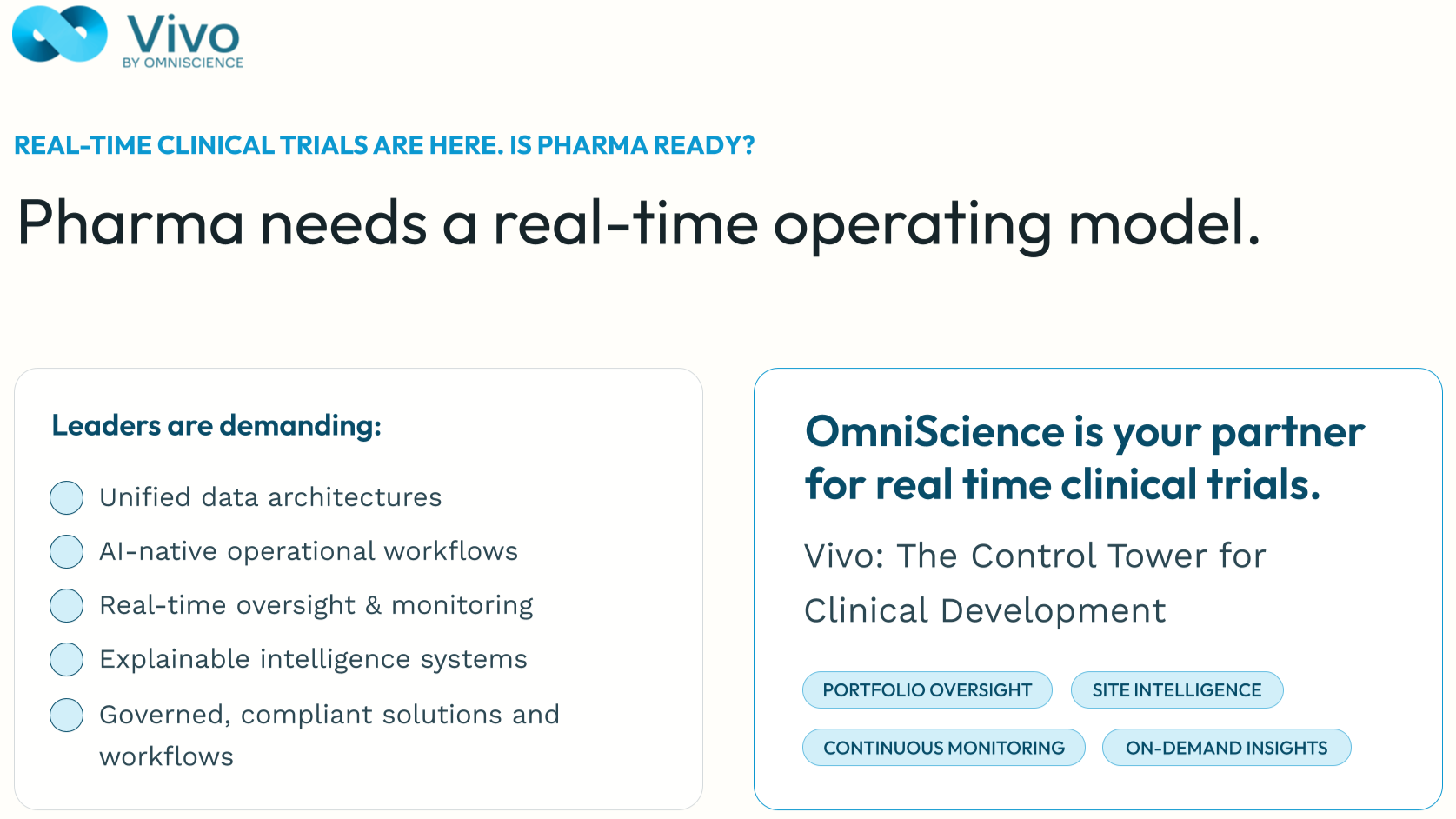
Real-time clinical trials will be a three-way partnership between regulators, sponsors, and technology platforms. The shift is already underway. Whether or not a given trial team is engaging directly with the FDA's initiative today, the underlying need is the same: a unified, real-time, compliant data foundation that turns clinical trial oversight from a periodic look-back into a continuous, actionable view.
To request a copy of the webinar please contact hello@omniscience.bio.
Connect with us
Our mission is to transform clinical trial operations to deliver life-changing medicines to patients faster. We built Vivo, the first agentic AI-powered control tower for clinical trials.
Vivo unifies fragmented clinical, safety, and operational data, and delivers real-time, explainable insights, putting teams ahead of the trial, not behind it. To learn more about Vivo, contact us at hello@omniscience.bio or connect with us on LinkedIn.
